
When a collision happens, the seconds that follow feel like chaos — adrenaline surges, phones start ringing, and everyone involved begins making rapid decisions that will echo for months or years to come. According to the National Highway Traffic Safety Administration’s 2023 data, approximately 6.7 million police-reported crashes occurred nationwide, yet thousands more collisions go undocumented each year when drivers choose to “handle things privately” or assume minor damage doesn’t warrant official reporting.
This gap between what gets reported and what actually happens on America’s roads has real consequences. Insurance companies increasingly rely on official documentation to process claims fairly, while state laws continue to tighten reporting requirements across jurisdictions. For anyone standing on the roadside after an accident — whether it’s a minor fender-bender or a serious collision — understanding when and why to file a police report can determine whether the resolution process unfolds smoothly or becomes a prolonged battle over disputed facts.
The decisions you make in those first critical moments don’t just affect paperwork. They shape how insurance adjusters evaluate your claim, how accurately the incident gets documented for legal purposes, and whether you’ll have the evidence you need if disputes arise later. Here’s what you need to know about navigating this process effectively, from the immediate aftermath through the long-term implications.
Why Timely Filing of a Police Report Matters After a Car Accident
State laws vary significantly on when filing a police report becomes mandatory, but the legal threshold is often lower than most drivers realize. In many jurisdictions, any accident involving injury, death, or property damage exceeding $1,000 to $2,000 requires an official report — and with modern vehicle repair costs, even seemingly minor damage frequently crosses these thresholds. Some states mandate reporting for any collision where vehicles can’t be safely driven away, regardless of damage estimates.
The consequences of failing to file when legally required extend beyond potential fines or citations. Missing the reporting window can create a domino effect that complicates every aspect of your claim. Insurance companies may question why no official documentation exists, potentially viewing the absence of a police report as a red flag that suggests the accident was more complex or contentious than initially presented.
Timing becomes critical because most states impose strict deadlines for reporting — typically 24 to 72 hours after the incident. California requires reporting within 24 hours for accidents involving injury or death, while Texas extends this to 10 days for property damage exceeding $1,000. However, waiting days to report often means crucial evidence has disappeared: skid marks fade, debris gets cleared, and witness memories become less reliable.
Beyond legal compliance, prompt reporting protects your interests in unexpected ways. If the other driver initially seems cooperative but later disputes fault or claims injuries that weren’t apparent at the scene, having an official report filed immediately becomes invaluable. Police documentation establishes an objective timeline and creates a contemporaneous record that’s much harder to challenge than conflicting personal accounts provided weeks later.
Even in states where reporting isn’t legally mandated for minor collisions, filing creates a paper trail that insurance companies respect. The official nature of police reports carries weight in claim investigations precisely because officers are trained to document accidents impartially, interview all parties, and note relevant factors like road conditions, weather, and visible damage patterns.
What Steps to Take Immediately After a Car Accident Before Filing a Police Report
The moments before police arrive set the foundation for everything that follows, and taking the right actions can significantly improve the quality and accuracy of the eventual report. Move to safety first — if vehicles are drivable and blocking traffic, move them to the roadside or nearest parking area, but take quick photos of the original positions before moving anything. This preserves crucial evidence about point of impact and vehicle trajectories that officers will need for their reconstruction.
Once everyone is safe, resist the urge to discuss fault or apologize, even for minor inconveniences like blocking traffic. Comments like “I’m so sorry” or “I didn’t see you” can be misconstrued as admissions of liability and may appear in the police report if overheard. Stick to factual information: what you observed, where you were going, and basic details about the collision sequence. Save your detailed account for the responding officer.
Exchange essential information with other drivers — names, phone numbers, insurance details, and license plate numbers — but avoid extensive discussions about what happened. This isn’t the time to negotiate or reach agreements about responsibility. Other drivers may seem reasonable at the scene but change their story later, making your initial documentation crucial for maintaining consistency.
Contact law enforcement even if the other party suggests handling things privately, especially if there’s any injury, significant property damage, or if something feels off about the other driver’s behavior or insurance information. Some drivers who suggest avoiding police involvement are uninsured, driving without valid licenses, or trying to prevent discovery of other violations. A request to “keep this between us” often signals complications ahead.
While waiting for officers, begin your own documentation process. Take photos of all vehicles from multiple angles, capture license plates clearly, and document the overall accident scene including traffic signals, road conditions, and any relevant signage. If there are witnesses, politely ask for their contact information and a brief statement about what they observed. This preliminary evidence gathering ensures nothing gets missed and provides backup documentation for the official report.
How to Document a Car Accident Effectively for the Police Report
Preserving Evidence and Gathering Witness Statements
Physical evidence disappears quickly at accident scenes, making immediate documentation essential for supporting an accurate police report. Modern smartphones make this process straightforward, but there’s a strategic approach that ensures you capture what matters most. Start with wide shots that show the overall scene, including all vehicles involved, their positions relative to traffic lanes, and any visible road markings or traffic control devices. Then move to closer shots that clearly show damage patterns, license plates, and specific points of impact.
Witness statements carry significant weight in police reports, but only if they’re collected properly. Look for people who actually saw the collision occur — not those who arrived afterward and are speculating about what happened. Pedestrians, nearby business employees, and drivers stopped at traffic lights often provide the most reliable accounts because they had clear sightlines and no stake in the outcome.
When approaching witnesses, be respectful and brief. Explain that police are coming and ask if they wouldn’t mind providing their contact information and a quick statement about what they observed. Don’t coach them or suggest what you think they should have seen. Simply ask: “Can you tell me what you witnessed?” Most people are willing to help if approached politely, but some may be reluctant to get involved officially. Even if they won’t give a formal statement to police, having their contact information allows insurance investigators to follow up later.
Document the witness information thoroughly — get full names, phone numbers, and note exactly where they were positioned when the accident occurred. This positioning detail becomes crucial because it establishes their vantage point and helps officers evaluate the reliability of their observations. A witness standing 200 feet away at an angle may have seen different things than someone waiting at the crosswalk directly ahead.
Describing Vehicle Damage and Other Accident Details
Accurate damage documentation requires more than quick snapshots of crumpled bumpers. Police officers use damage patterns to reconstruct collision dynamics, determine impact speeds, and assess fault, so detailed photography directly supports their analysis. Capture each damaged area from multiple angles, showing both the extent of damage and its location on the vehicle. Pay particular attention to height differences in impact points, which can reveal important details about the collision sequence.
Note the condition of all vehicles involved, not just your own. Look for pre-existing damage that should be distinguished from fresh collision damage — rust patterns, paint fade, or repair work that’s clearly older than the current incident. This prevents disputes later about which damage resulted from this specific accident versus previous incidents or general wear.
Road and weather conditions significantly influence how accidents occur and how officers assign responsibility. Document wet pavement, ice, construction zones, obscured sight lines, or malfunctioning traffic signals. These environmental factors often play crucial roles in determining fault, particularly in cases involving failure to yield or following too closely. An officer might assign different levels of responsibility if they know the roadway was slick or visibility was compromised.
Vehicle positions matter enormously for police reconstruction efforts. Before moving cars to safety, take photos that clearly show where each vehicle ended up relative to lane markings, curbs, and intersection boundaries. If vehicles have already been moved, do your best to describe their original positions to the responding officer, and mention that you have photos showing the scene before cleanup.
When describing the accident sequence to police, stick to what you directly observed without speculating about the other driver’s intentions, distractions, or mental state. “The blue sedan entered the intersection after the light turned red” is factual. “The other driver was texting and ran the red light” includes assumptions unless you clearly witnessed phone use. Let the officer draw conclusions based on evidence rather than interpretations.
How Police Document and Investigate Car Accidents On Scene
Police Investigation and Fault Determination
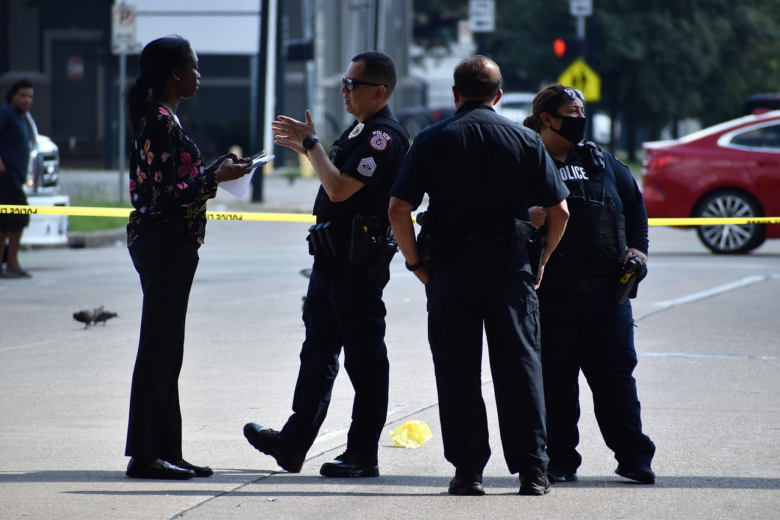
Police officers arrive at accident scenes with training in crash reconstruction techniques and a systematic approach to determining fault based on physical evidence, witness statements, and traffic law violations. Their investigation process begins with securing the scene and ensuring medical needs are addressed, but quickly moves into evidence collection that will form the backbone of their official report.
Officers typically start by interviewing all drivers and passengers separately to get independent accounts of what happened. They’re trained to ask specific questions about timing, speeds, directions of travel, and decision points leading up to the collision. These interviews aren’t casual conversations — officers are looking for consistency between accounts and physical evidence, and they note any contradictions or gaps in the stories provided.
The physical evidence examination often reveals more about fault than driver statements. Officers measure skid marks to estimate speeds, examine impact points to determine angles of collision, and assess vehicle positions to understand collision dynamics. They’re particularly interested in which traffic laws were violated and whether those violations directly contributed to the accident. A rear-end collision typically suggests following too closely, while impact damage to the side of a vehicle often indicates failure to yield right-of-way.
Technology increasingly supports these determinations. Many police departments now use laser measurement tools to create precise accident scene diagrams, and some officers have access to collision reconstruction software that helps them analyze impact angles and speeds. However, the fundamental process still relies on combining physical evidence with witness testimony and driver statements to create a coherent picture of how the accident occurred.
Fault determination in police reports doesn’t always assign 100% responsibility to one party. Officers can note contributing factors for multiple drivers, such as excessive speed by one driver combined with failure to yield by another. These nuanced determinations often prove crucial during insurance claim negotiations, where shared fault can significantly affect settlement amounts. When individuals work with a car accident lawyer in Indianapolis, having detailed police documentation of these contributing factors becomes essential for building a comprehensive case strategy.
Officer Narratives, Diagrams, and Sketches in Reports
The narrative portion of police reports carries particular weight because it represents the investigating officer’s professional assessment of how the accident occurred. This isn’t just a summary of what drivers told them — it’s their conclusion based on all available evidence, written in objective language that insurance companies and courts treat as authoritative. Officers typically organize these narratives chronologically, starting with the events leading up to the collision and proceeding through the impact and aftermath.
These narratives incorporate details that drivers might not think to mention but that prove significant for liability determination. Officers note whether drivers were wearing seatbelts, whether airbags deployed, and whether vehicles showed signs of sudden braking or evasive maneuvers. They document distracted driving indicators they observe, such as phones within easy reach, and note any statements drivers make about not seeing the other vehicle or being surprised by the collision.
Police diagrams and sketches provide visual documentation that complements the written narrative. These aren’t artistic renditions — they’re scaled drawings showing vehicle positions, impact points, debris fields, and relevant road features like traffic signals and lane markings. Many officers use standardized symbols and notation systems that other professionals in insurance and legal fields understand immediately.
The sketches often include measurements between key points — how far vehicles traveled after impact, distances from intersection boundaries, and spacing between vehicles in multi-car collisions. This quantitative information supports the officer’s conclusions about speeds and impact forces, providing concrete data that insurance adjusters use to validate or question driver statements about the collision sequence.
Modern police reports increasingly include digital photographs as official attachments, documenting damage patterns, road conditions, and overall scene layout. These photos become part of the permanent record and are often more detailed than what individual drivers capture during the stressful moments after an accident.
How Police Reports Impact Insurance Claims and Legal Outcomes
Insurance companies structure their claim investigation processes around police reports as primary source documents, treating them as more reliable than conflicting statements from involved parties. When adjusters receive claims, they typically request the police report immediately and use it to establish their initial assessment of fault and liability. The officer’s determination carries significant weight because it comes from a trained, impartial professional who examined physical evidence while it was still fresh.
Claims involving disputed fault often hinge on specific details documented in police reports. If one driver claims the light was green while the other insists it was red, adjusters look to the police report for witness statements, impact damage patterns, and the officer’s assessment of traffic signal timing. Without this official documentation, insurance companies face a “he said, she said” situation that’s much harder to resolve fairly and efficiently.
The financial implications extend well beyond simple liability determinations. Police reports that document injuries, even those that seem minor at the scene, create official records that support medical claim components. If symptoms worsen or new injuries emerge in the days following an accident, having these conditions noted in the original police report prevents insurance companies from arguing that injuries were pre-existing or unrelated to the collision.
Legal proceedings rely heavily on police reports as foundational evidence, particularly in personal injury cases where establishing fault becomes crucial for determining damages. Attorneys use police reports to identify witnesses, understand the accident sequence, and build their case strategies. The official nature of these documents means they’re typically admissible in court without requiring the investigating officer to testify, though officers can be called to explain their findings if needed.
The long-term value of police reports often becomes apparent months after an accident, when initial settlements prove inadequate or when the full extent of injuries becomes clear. Having thorough official documentation from the scene provides a solid foundation for reopening negotiations or pursuing legal action. Without this documentation, proving that current medical issues or ongoing vehicle problems stem from the specific accident becomes significantly more challenging.
For anyone involved in a collision, understanding how police reports influence these downstream processes emphasizes why accuracy and completeness matter so much in those critical first hours. The extra time spent ensuring thorough documentation often proves invaluable when the stakes become clear and the long-term consequences begin to unfold.

Disclaimer: Guest Posts don’t reflect the views and opinions of Crankshaft Culture. Articles include links to websites for products and services. Crankshaft Culture receives a monetary commission for each guest post.
Leave a Reply