
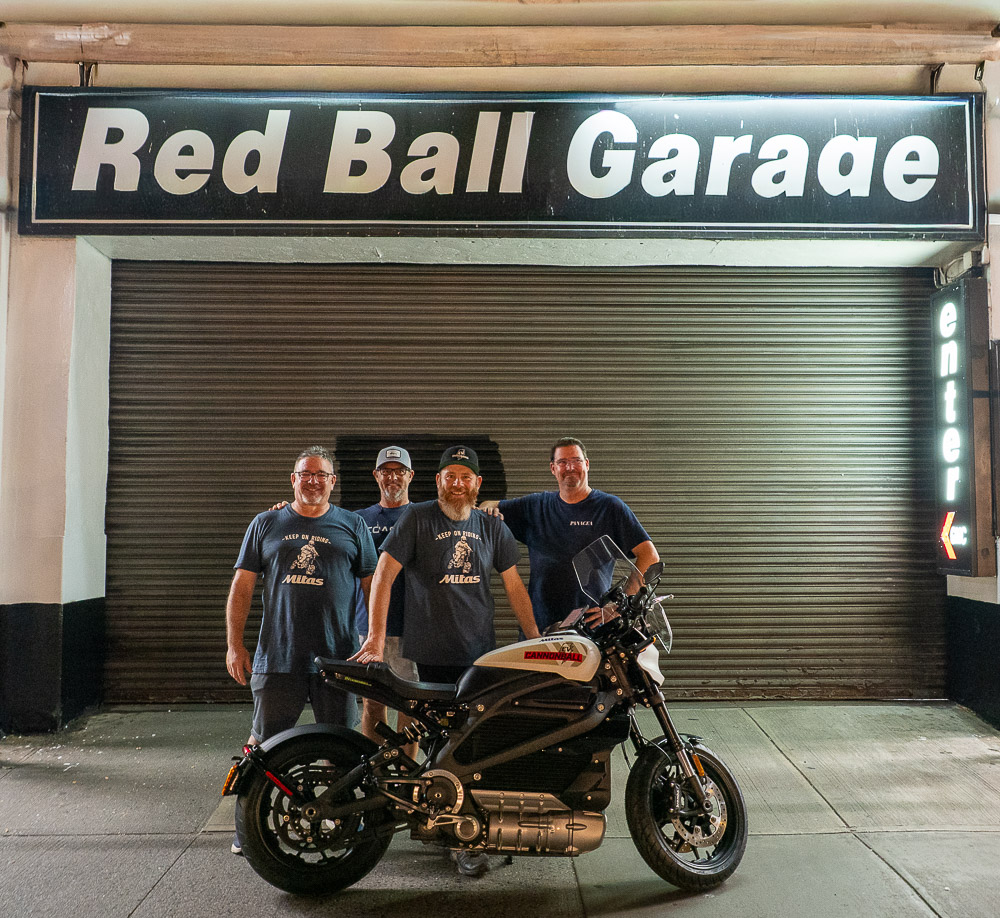
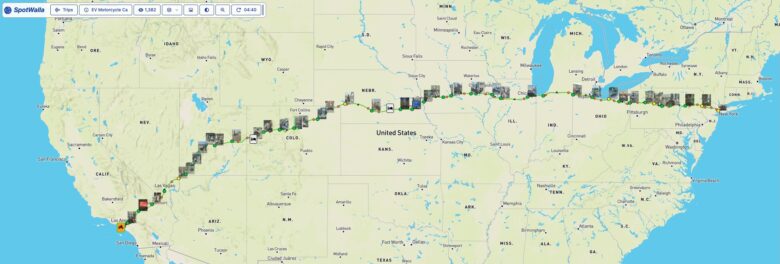
Motorcycle enthusiast and owner of the ADV Cannonball Motorcycle Rally and Podcast, Aaron Pufal, has set a new record for crossing the USA on an electric motorcycle. The endeavour, which finished August 6, 2026, took 100 hours and 17 minutes. The record was set on an electric 2021 Harley-Davidson LiveWire One. The Cannonball attempt started in New York City and ended at the famous Portofino Hotel in California.
“I climbed onto a 2021 Harley-Davidson LiveWire One, an electric motorcycle I had never ridden before, not this one, not any electric motorcycle, period. I’d driven the empty support van solo from Seattle to North Carolina to pick the bike up, sleeping in parking lots along the way, then spent two more days pushing north to New York for a symbolic midnight start,” said Pufal in a release sent to Crankshaft Culture. He said he was learning how his own motorcycle worked in real time.
Reality Check
Pufal says the first hours were chaos and joy in equal measure. “Lane filtering silently through the Lincoln Tunnel, I realized for the first time just how fast my electric motorcycle really was,” he said. Pufal said the bike was a silent rocket ship slipping through gridlock that would have swallowed a gas bike whole.
“Once free of the city, I opened the throttle, ripping along at 70, 80, even 100 MPH, thrilled, and burning energy at a wildly inefficient 190 watt hours per mile. It was fun. It was also, I now laugh, completely the wrong way to break a distance record,” he said.
To make matters worse, within those first 24 hours, Pufal was inundated with heavy rain, wind, and lightning squalls all the way to Chicago. After 22 hours of riding and being awake for 45 hours, Pufal and the team finally stopped at a roadside restaurant.
“We ran the math and didn’t like what we saw: a pace on track for five days and well over 125 hours. Over beers and chicken wings, we rebuilt our entire approach,” Pufal mentioned. They divided responsibilities, wrote policies, and most importantly, agreed to stop guessing and start testing, he stated.
Cracking the Code
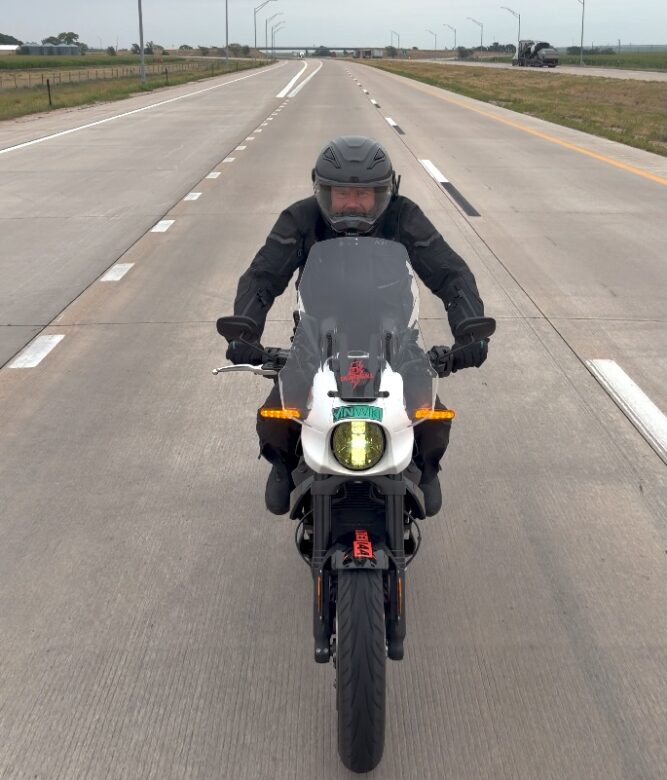
“We turned to hard data instead of instinct,” Pufal said. They turned to their resident robotics engineer, Steve, to design a series of controlled tests. They rode them, holding the bike at steady 55 and 65 MPH, then experimenting with drafting distance behind the support Sprinter van, while Steve recorded and analyzed the data in real time. The winning formula turned out to be 109 watt hours per mile, tucked in at roughly one bike length behind the van at 65 MPH.
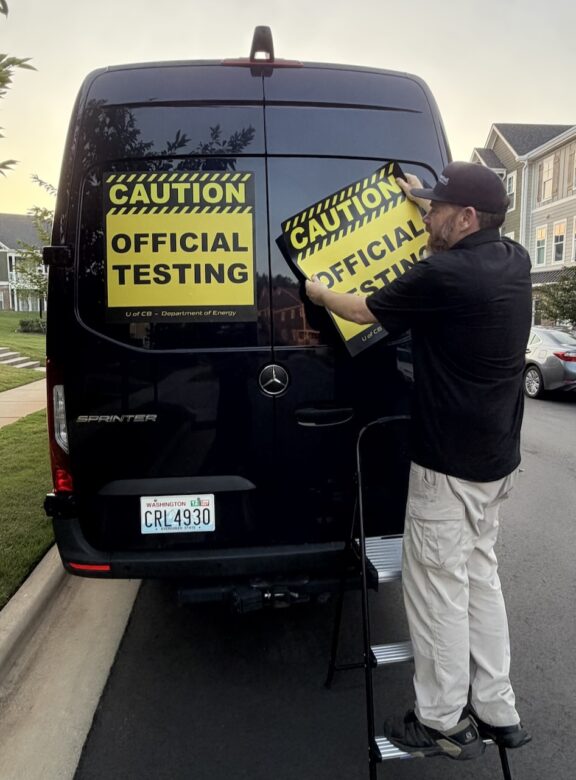
To make that drafting arrangement safer and less conspicuous, they stuck oversized magnetic signs on the van reading University of C.B., Department of Energy, and mounted a couple of strobe lights up top. It looked official enough that people assumed they were some kind of research convoy. Pufal says the real purpose was safety, making sure other drivers gave them a wide, cautious berth while he rode tucked in close behind the van for hours at a time. He admits that closeness was always a negotiation between speed and risk.
“We’d overinflated our Mitas street tires to 50 PSI chasing a little extra efficiency, but it turned the ride so brutally stiff we had to deflate them back to spec, and even then the LiveWire’s solid aluminum alloy wheels and tight suspension rattled my teeth,” said Pufal. Drafting bought them efficiency but carried its own danger; tucked in tight, rough pavement could catch Pufal by surprise and send the bike airborne for a heartbeat before he could react.
“Some stretches were so relentlessly rough that getting battered around back there was too dangerous to justify, no matter the gain. So when the roads turned bad enough, or rain set in, or night fell and reaction time mattered more than watt hours, we simply pulled out front and gave up the draft. Some things weren’t worth the risk,” he said.
Why Play Such a Stupid Game?
So why would anyone willingly play a game this “stupid?” (Pufal’s own words.)
“People often ask why I didn’t just go for the outright record instead of the electric one. The honest answer is money, manpower, and risk,” he confessed.
The fastest Cannonball Run of all, in any vehicle, belongs to Arne Toman, Doug Tabbutt, and Dunadel Daryoush, who crossed the country in a staggering 25 hours and 39 minutes. Attempts like that aren’t cheap either; teams typically spend more than $100,000 just to buy and build a car capable of it, before factoring in the cost of actually running it.
Pufal also mentions it’s rarely solo act. A run like Tabbutt’s takes a genuine team effort, often 20 or more people. At the heart of it sits central command, coordinating the run in real time. They plot traffic strategy, use AI to predict congestion further down the route, track weather in real time and lean on weather forecasting, watch traffic cameras, monitor police scanners, tap into public and other databases for real-time law enforcement activity, and even track airborne police assets, sometimes rerouting the car around traffic and accidents on the fly.
Out on the road is a rolling network of “blockers” watching what’s ahead. Some will deliberately run in front of the record car and draw a traffic stop onto themselves, taking the ticket so the team behind them can blow through uninterrupted. And that’s before you count everyone who helped build and prep the car in the first place. Some record attempts have gone even further, employing their own aircraft escorts. Alex Roy famously used a twin-engine plane to help spot for police during his record run in the Polizei 144 BMW M5, when he and co-driver David Maher crossed the country in 31 hours and 4 minutes back in 2006.
Two-Wheel & Three-Wheel Records
On two wheels, the record belongs to Beau Earnest, who did it in 32 hours and 32 minutes.
“Beau’s a friend; we’ve actually had him on our podcast,” said Pufal, “and I have enormous respect for what he pulled off. But that record demands sustained speeds well north of one hundred miles an hour for long stretches, and for reasons specific to my own personal circumstances, the legal exposure that comes with that kind of run is a risk I’m simply not in a position to take.”
And on three wheels, Alex Roy went again, this time with co-driver Zach Bowman, crossing from Los Angeles to New York in a 2013 Morgan 3 Wheeler in 41 hours and 49 minutes. Open-topped, wood-framed, two cylinders, no concessions, in November, averaging 80 MPH while dodging winter’s first storms. He called it Stalingrad on wheels, and an icepick in the face of commoditized gravitas.
“I’ve got my eye on that record. My therapist has questions,” Pufal jokes. “So instead, I set my sights on something nobody had officially done before, proving an electric motorcycle could make the crossing at all.”
Smoke Red Sunrise
Their support van ran into a snag near Vail Pass, and it dropped into limp mode partway up the climb. This forced them to creep the rest of the way over the summit at a crawl. They finally stopped in Grand Junction for four hours of real sleep, and while the rest of the team slept, Pufal stayed up troubleshooting the van’s limp mode error code, tracking it down and clearing it so they could roll out at full strength come morning.
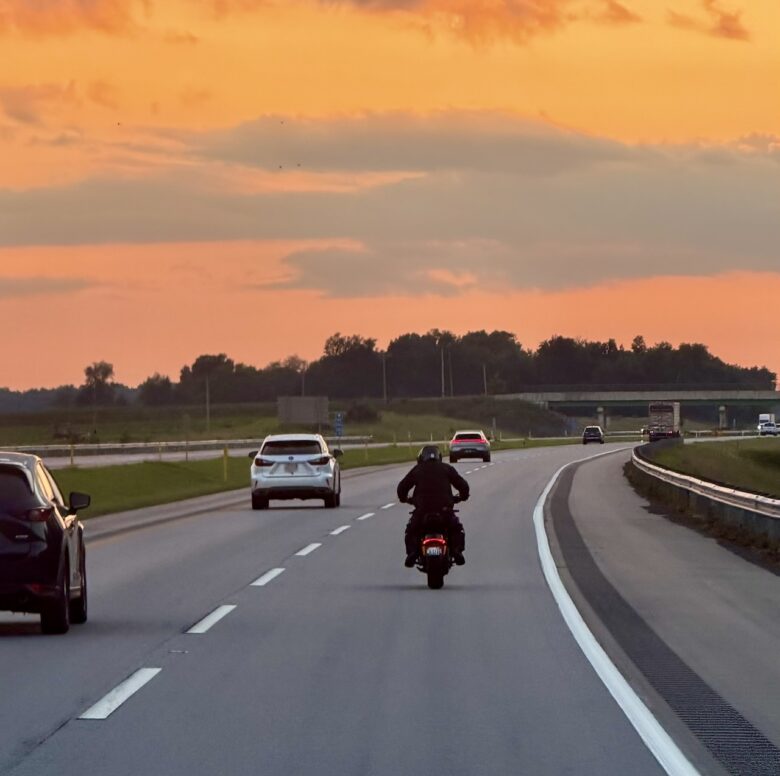
Not long after, they rode through a smoke-red sunrise, the sky stained by distant wildfires, an ominous backdrop for what came next. By this point they’d been measuring thermal performance and watt hours obsessively for more than 60 hours straight, and the data was about to matter more than ever, because they were riding straight into a war with desert heat.
The World Was on Fire
The group quickly realized the real war wasn’t with speed or range anxiety; it was heat. Specifically, keeping the battery’s own temperature under control while they discharged and recharged it continuously, hour after hour, for the better part of 100 hours straight, with no real break to let it cool.
“Across the whole run we performed 47 separate level three DC fast charges, and it was that relentless cycle of repeated fast charging that drove the internal battery temperature to its worst, swinging brutally from a manageable 79 degrees to a scorching 118 degrees after back-to-back sessions. Once it climbed too high, thermal throttling kicked in hard on the charging side. Where a cool battery would happily pull as much as 20 kilowatts, a badly overheated one could crawl down to just five, dramatically slowing how fast we could refill it. Discharge, oddly enough, was never the problem; if anything, the bike delivered its power just fine in the heat; it was getting energy back into the battery that ground to a halt,” said Pufal.
On the final day, air temperatures in Utah, Nevada, and California hit 113 degrees, and the heat started attacking the hardware itself. And the land was burning. All three states were literally on fire, wildfires chewing through the high desert and the forests beyond, and the smoke hung so thick in the air that every breath felt borrowed.
“I was riding through a furnace that someone had forgotten to ventilate, the sun reduced to a dull orange coin behind a curtain of ash. There’s a particular kind of loneliness in racing across a continent that appears to be actively trying to cremate itself, and somewhere in that haze I stopped thinking of the heat as weather and started thinking of it as an opponent with a grudge,” Pufal said.
The retention pin on the DC fast charging socket itself actually warped from the heat, and the bike’s own software started glitching—what we jokingly called “ghosts in the code,” until a full reset of the bike’s systems got things stable again.
“Even our phones were overheating and shutting down. I ended up rationing water across each leg, keeping bottles stuffed in my pants pockets since I wasn’t wearing a jacket, and every so often I’d crack one open and pour it straight over my body to cool myself down, carefully spacing them out to make sure I had enough to keep from physically overheating before the next charging stop,” said Pufal.
No Such Thing as an Easy Charge
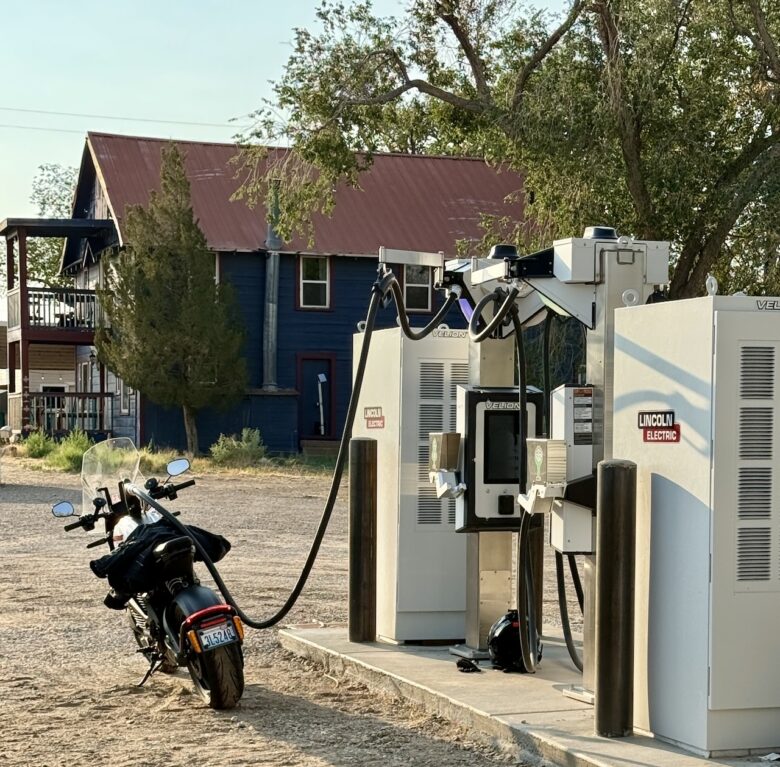
Pufal said they learned early, and the hard way, never to roll into a dubious, poorly documented charging point running on fumes whenever they could help it. Arriving with a little margin left in the pack meant that if a charger turned out to be dead, missing, or on the wrong side of the interstate, they still had options, rather than being forced to fall back on the onboard level one charger, which takes hours to add meaningful range instead of the near minutes we got from the level three fast chargers we relied on.
“That said, we also leaned heavily on real-time online charger statistics, and at some of the more popular, well-used stations we could actually see that a charger had been used that same day successfully, sometimes only hours before. In those cases, confident in our own data and our consumption numbers, we’d let ourselves come in on as little as one percent, as we did several times, weighing the totality of the circumstances and genuinely pushing the limits, and getting away with it,” said Pufal.
He said not every charger cooperated. Sparse, gray-market charging stations along their rural route worked as little as one in four tries, and addresses often pointed them to empty desert instead of an actual charger, forcing them to lean on satellite maps and the van’s Starlink connection to hunt down the right spot.
“I’d imagined, before any of this started, that charging stops would be small mercies, a chance to lie back and nap while electrons did the work,” Pufal explained. “The reality was the opposite. Every stop was packed wall to wall with tasks: cleaning a dirty visor, recharging comms and strobe lights, double-checking the routing app’s next charging stop recommendation, rehydrating, shoving some food in your face, and relieving yourself at record pace, because on a run like this even a number two becomes a strategic decision with a stopwatch running. Nobody rested. If anything, the stops were busier than the road.”
Sleep, the Enemy’s Weapon
Sleep, or the lack of it, became the enemy’s sharpest weapon against the group. After a grueling first day and a six-hour sleep to recover, they adopted a rule: Once the sun went down, two people stayed awake in the van at all times, because drafting mere feet off the bumper at night meant a single moment’s delay spotting road debris could cause a serious crash.
“We stayed connected the whole way through, me in helmet comms with in-ear monitors, my driver and co-driver on their own mesh network headsets, so a warning could travel instantly,” Pufal said. He continued,
“By day two, the pain and fatigue were real enough that I started keeping loose ibuprofen in my pants pocket, just to get through each leg.”
The All-Star Team
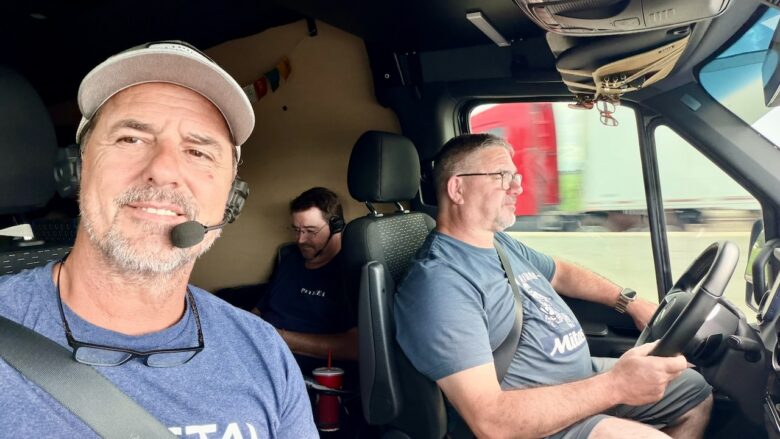
What began as a crew of four became three after Hunter Wray, a US combat veteran and the overall winner of the 2025 ADV Cannonball Rally, had to fly home from Denver. The rest leaned hard on their individual strengths. As a former yacht captain, Pufal knew that surviving something like this isn’t about muscling through on willpower, testosterone, and caffeine. Rather, it’s about disciplined watch systems.
“Running a boat on long passages taught me how to structure a rotation, when to put people down to rest and when to wake them, so that fatigue never got the chance to compromise the mission,” said Pufal. “I brought that same approach to organizing our shifts and keeping the team sharp around the clock. Beyond that, I was really just the dummy riding the motorcycle.”
Steve Walmsley, a robotics engineer and computer programmer, brought the technical rigor behind the team’s data-driven testing, and it was Steve who recorded every data point along the way and led the post-attempt analysis that would make sense of it all.
Kerry LeBel, a former executive at Amazon and Microsoft and currently a successful entrepreneur, and the editor of Pufal’s last book, “Chasing Legends,” stepped up as the team leader and chief engineer. He became the main driver and took charge of charger planning, making optimization calls that seemed counterintuitive at first but proved out as the rest of the team caught up to his logic. Kerry’s an accomplished rider himself, which meant he understood exactly what Pufal was dealing with out there on the bike. They learned to trust the math, even when it defied instinct; some charging stops were as little as 45 miles apart, while others stretched out to a hundred.
Ghosted by LiveWire
One frustration lingered the whole way through for the team. Pufal said they reached out to LiveWire before the attempt, hoping for technical guidance on battery behavior and charging optimization, and never heard so much as a word back. “Apparently the ghosts weren’t just in the code,” said Pufal. He said a single conversation with an engineer might have saved them hours they otherwise spent learning by trial and error.
“That said, credit where it’s due, this was clearly no corner-cutting machine thrown together to hit a price point. It’s an extremely well-engineered, well-built motorcycle, and apart from those heat-related software gremlins I mentioned earlier, it never had a single real mechanical issue while crossing the continent.”
When electric motorcycles see wider adoption, Pufal says he has no doubt manufacturers would iron out those last few quirks quickly, but the bones of this bike, the engineering underneath it all, deserve real praise.
Russian Roulette
At that last charging stop, they stood around debating the one calculation that mattered most, how much charge was actually enough.
“It came down to a negotiation between me and physics; I kept insisting I could ride faster, and the battery kept quietly disagreeing, with the laws of thermodynamics refereeing, and they don’t take bribes,” said Pufal. “Whatever we decided, we were already committed to playing the world’s stupidest game of Russian roulette; the only question was how many chambers we wanted loaded. Stop too long, and we’d throw away precious time we couldn’t spare. Stop too little, and picture crossing thousands of miles of mountains, deserts, and lightning storms, only to coast to a dead, silent stop on some Los Angeles surface street, two miles from the finish, stranded like a kid who blew his whole allowance on candy in the first five minutes.”
While they debated, they did a live broadcast to the C2C Express Facebook page, alerting their “Fraternity of Lunatics,” the die-hard cannonballers who’d followed us the whole way, to make sure enough people were watching and ready to help officiate the finish.
One Last Gamble
Leaving that last charging stop, the math was done, and the dice were already in the air. “I wanted to race the last stretch righteously. Not necessarily as fast as humanly possible, but hard enough that the finish would be worthy of everything that came before it, and still not so hard that I’d coast to a stop short of the line,” said Pufal
He rode the section like a puzzle. Over 100 MPH for long stretches, then easing back to 60 to watch where the battery would settle, recalculating with every mile, hunting a finish that would land with one or two percent left in the pack. And just as critically, making sure the soundtrack in Pufal’s helmet was correct, Rage Against the Machine hammering in his ears as Los Angeles blurred past on either side. “It was every bit of pace I could pull out of that bike without gambling the whole record on the last few miles,” he said.
“But let me be clear about one thing. No matter how disciplined and scientific the previous 100 hours had been, the ending could not be a polite little drafting exercise,” said Pufal. “Picture telling this story years later on a channel like VinWiki, in a studio still holding the echoes of every legend who sat in that chair before you. You simply cannot look into a camera and say the climax of your Cannonball was tucking neatly behind a van and coasting gently to the line. No. A Cannonball story has to be earned. The gravitas of an attempt like this demands the respect of real speed at the end, for the sake of everyone who came before me.”
He contined, “What would they have thought if I rolled up to the Portofino at a leisurely 30 miles an hour? These are cannonballers; they deserved better than that, and honoring them properly was the least I could do. The mission had been a grueling marathon, but the finish, the finish had to be a sprint.”
Into the Books
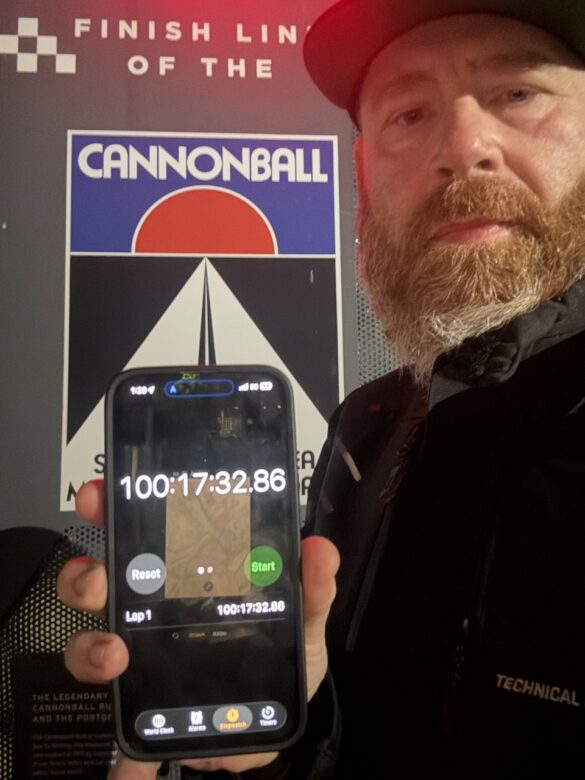
Pufal crossed reached the Portofino Hotel & Marina in Redondo Beach, CA in100 hours and 17 minutes, a new record.
“I know for a fact we could have clawed back 17 minutes in a dozen small ways,” said Pufal. “We’d taken the northern route, more than 2,959 miles in total, and put the bike on a charger 47 times to do it. And true to the cliché of every cannonball attempt before mine, the finish itself was almost comically anticlimactic. No crowd, no fanfare, just a handful of photos, a few congratulatory comments from the diehard cannonballers who’d stayed up all night on the tracking app to witness and officiate, and then straight to the hotel to pack the bike away and collapse.”
The next day, Pufal said he was sore in ways he hadn’t anticipated, nursing windburn and sunburns, with a 50-year-old body filing its complaints one joint at a time; they finally got their real celebration, beers and dinner at the hotel, including one fittingly named Cannonball Run I.P.A.
Setting the Record Straight
Earlier riders have claimed similar electric crossings, including one reported seven-day attempt by Diego Cardenas on a Harley-Davidson LiveWire, and another claimed run of 111 hours in the reverse direction by Steven Day on an Energica EVA Ribelle.
“To be clear, I’m not disputing either run. Both riders were generous with their support in real time throughout ours, and I’m grateful for it,” Pufal stated. “I simply wanted mine held to the gold standard, approved in advance by Cannonball record holders and verified throughout via GPS tracking and community spot checks, the same standards used for the sport’s traditional gasoline-powered records.”
What Comes Next?
“Looking back, I realize we never once test rode the motorcycle before leaving the Red Ball Garage [in New York], a decision that made for a funny story but cost us significant time,” Pufal quipped. He keeps a private list of changes he’d make to shave hours off the record, though he won’t be doing it again on this particular LiveWire, but the idea of chasing his own record on a newer, more cutting-edge machine is tempting, especially bikes built around removable battery packs, which could change the entire charging equation.
Chasing “Baker’s Ghost”
“There’s something fitting in all of this, too. In 1914, riding an Indian motorcycle that was still very much unproven technology, Erwin ‘Cannonball’ Baker rode from San Diego to New York in 11.5 days, shattering the previous transcontinental record by nearly nine days, on roads that were mostly dirt, with no support network, no spare parts network, nothing but grit and a machine that had barely been tested at that distance,” Pufal stated. He went on to say Baker went on to set the Three Flags record from Canada to Mexico the following year, and eventually crossed the country by car too, in 53.5 hours, the very run that decades later inspired the Cannonball Run races and eventually the movies that made his name a household word.
Pufal notes that Baker was always chasing the newest, least-proven technology of his moment, first motorcycles that had only existed for a decade, then early automobiles nobody trusted to survive a cross-country trip.
“I should say clearly, I’m no evangelist for electric vehicles or green technology, and before this trip I’d genuinely never so much as laid eyes on an electric motorcycle in person. But let me be just as clear about the clowns on the other side. I’ve got zero patience for the muppets who insist windmills cause cancer, that clean coal is anything other than an oxymoron with a lobbying budget, or that every electric vehicle is one pothole away from bursting into flames before it can limp past the corner store. Both extremes are exhausting,” said Pufal.
“I didn’t do this to join a team. I did it for the oldest and most stubborn reason there is, because it was hard. Because somewhere along the way a thing being nearly impossible stopped being a warning and started being the entire point. Nobody needed an electric motorcycle dragged across a continent, and that’s precisely why it had to be me, and why it had to be now,” stated Pufal.
He says the engineering fascinated him, the challenge was real, and physics doesn’t check which team you cheer for before it decides how far a battery will go. “And for the record, I don’t cheer for any team. I just wanted to see if it could be done. It can.”
Pufal notes there’s a whole crowd of naysayers out there convinced electric motorcycles simply can’t do real distance, can’t be trusted beyond a joyride around town, and he and his team’s answer, every single time, was that it can go clean across the whole country, and, “for the record, in less time than most of you would manage in your five thousand pound G-Wagon with the air conditioning cranked and an eight dollar oat milk iced latte sweating in a cupholder that cost more than my helmet.”
“We did this because it was hard, and because somebody needed to prove it could be done,” Pufal exclaimed. He continued that in some strange way, doing this on an electric motorcycle felt like the closest thing to Baker’s original spirit left in the world today, strapping yourself to technology still being figured out in real time, and betting on it anyway. He said there’s a rawness to doing it this way that a gasoline crossing simply doesn’t demand anymore, being entirely dependent on someone else’s charging infrastructure, scattered, sometimes finicky, and not always where the map says it’ll be, while your own body is left exposed to whatever the sky decides to throw at you.
“And if this run pushes even one more rider to come chase this record down and beat it, then it did exactly what it was supposed to do,” Pufal said.
Smiles Per Mile
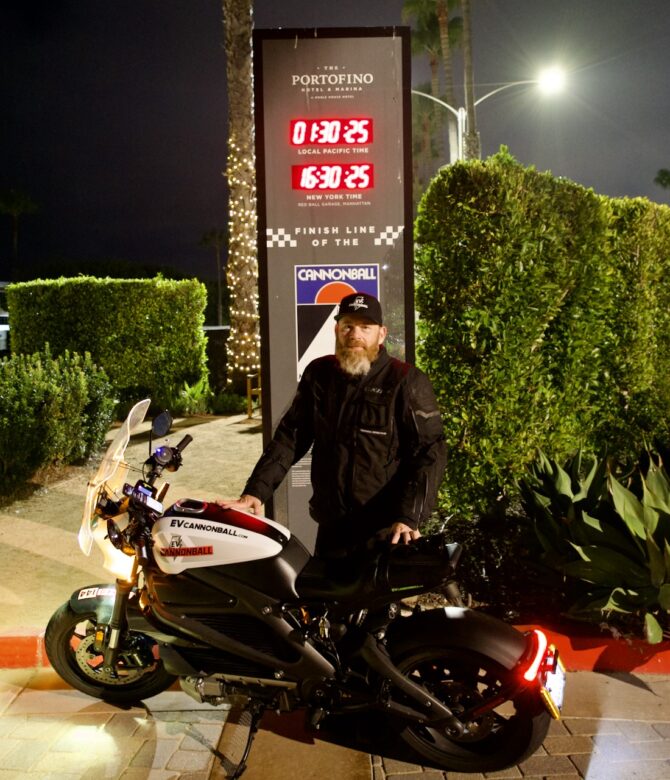
“One final thing. Now that it’s all done, I’ll admit something I didn’t expect to. This motorcycle is genuinely cool,” Pufal said. “Mind you, I still need to confirm it can pull a proper wheelie and hold a decent brake stand before I fully commit; a man has standards. But it’s fast as hell, scary fast, the kind of fast that rearranges your face, and for ripping around a city it’s an absolute riot. It puts a stupid grin on you every single time. And isn’t that the whole point of a motorcycle?”
Pufal had every intention of selling the thing the moment he crossed the finish line. He told himself he had no attachment to it, especially after being ghosted by LiveWire themselves. But a part of him is going to hang onto it. “I don’t know for how long; I don’t know how long the novelty lasts. But for now, I’m keeping the bike. Because it’s cool. Baker would have understood that part too.”
This story was based on a manuscript sent by Aaron Pufal. Photos provided by Aaron Pufal.
Andy Lilienthal is an award-winning writer and has written professionally since 1999. He has over 15 years in the automotive aftermarket working at companies including Warn Industries, Bushwacker, and Lund International. Editorial works include writing and photography for off-road print magazines, to new-car reviews online. He’s a photographer with images in multiple magazines, blog sites, and The New York Times.
Leave a Reply