
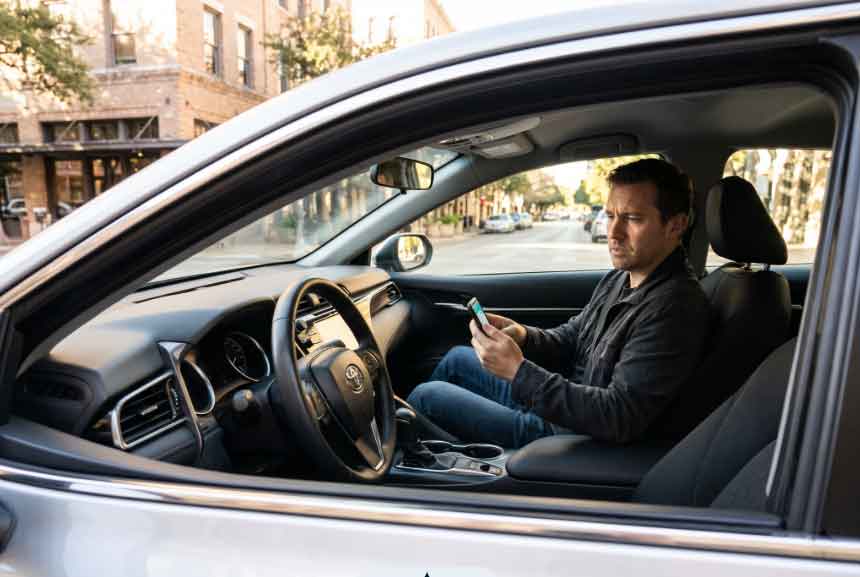
Most people who start driving for a rideshare platform think about the insurance question in terms of other people. If I hit someone, who pays them? That is the easier half. The harder half is what happens to the vehicle in your own driveway, because Texas law expressly permits your personal insurer to switch off coverage the moment you log in, and the part it switches off includes the coverage protecting your own car.
Texas Authorizes the Exclusion by Statute
What an insurer is allowed to exclude
Chapter 1954 of the Texas Insurance Code governs rideshare coverage. Section 1954.151 permits an insurer to exclude from a personal auto policy any loss or injury occurring while the driver is logged on to a transportation network company’s digital network, or is engaged in a prearranged ride.
The scope of that permission is the part drivers underestimate. The statute lists what may be excluded, and the list covers liability for bodily injury and property damage, personal injury protection, uninsured and underinsured motorist coverage, medical payment coverage, comprehensive physical damage coverage and collision physical damage coverage.
That is not a gap in one coverage. That is the policy.
The exclusion survives the financial responsibility rules
The same section provides that an authorized exclusion applies notwithstanding the financial responsibility requirement in Chapter 601 of the Transportation Code. A separate section confirms that nothing requires a personal auto policy to cover a driver who is logged on, engaged in a prearranged ride, or otherwise using a vehicle to carry passengers for compensation.
What the Company’s Policy Replaces, and What It Does Not
The platform’s coverage steps in according to app status. While a driver is logged on and available but not engaged in a prearranged ride, the required liability minimums are fifty thousand dollars for bodily injury per person, one hundred thousand per incident and twenty-five thousand for property damage. Once engaged in a prearranged ride, the requirement rises to a total aggregate limit of one million dollars for death, bodily injury and property damage.
Read those again with your own vehicle in mind. Every figure is a liability limit. Liability coverage pays other people. None of it repairs the truck you drove to work.
According to personal injury lawyer Nicholas R. Thompson, Principal and Managing Partner at RTRLAW, the dispute that catches drivers out is almost never about the million-dollar figure, which is usually available when a passenger is aboard, but about physical damage to the driver’s own vehicle during a period their personal carrier has excluded. Drivers who find themselves in that position sometimes consult a trusted advocate for Uber-related injuries once two insurers have each explained why the other one should handle it.
The Gap Hits Hardest on a Vehicle You Have Put Money Into
Comprehensive and collision are the coverages that pay for your own vehicle, and both appear on the list an insurer may exclude while you are logged on. For someone driving an ordinary commuter car, this is an expensive problem. For someone whose vehicle carries a lift, a winch, aftermarket bumpers or a roof rack worth more than the payments, it is a different order of loss. Hail in an open lot, a deer at dusk on the way to a pickup, or a single at-fault collision can fall into a window where neither policy is answering for the vehicle itself.
Three Ways Drivers Close the Gap
A rideshare endorsement
Most Texas carriers now sell an endorsement extending personal coverage into the logged on period. The statute expressly preserves an insurer’s ability to provide coverage it would otherwise be allowed to exclude. It is usually the cheapest fix and the one most drivers do not know to ask for.
A commercial auto policy
More expensive and more complete, and the usual answer for anyone driving enough hours that the vehicle is genuinely a work asset.
Reading what the platform actually offers
Contingent comprehensive and collision from a platform typically requires you to carry those coverages personally and comes with a deductible considerably larger than a standard one. It is worth knowing the number before you need it rather than after.
The Texas Department of Insurance explains how the individual coverages in an auto policy fit together in its auto insurance guide, which is a useful reference when comparing an endorsement against what you already hold.
One Procedural Point Worth Knowing
Chapter 1954 states that coverage under a policy maintained by the transportation network company is not contingent on the driver’s personal insurer first denying a claim. A driver does not have to collect a denial letter before the company’s coverage can be reached, which removes a delay that adjusters sometimes suggest is required.
What to Confirm Before the Next Shift
Pull up your declarations page and look for a rideshare endorsement by name. If it is not listed, assume the exclusion applies in full. Ask your agent in writing which coverages lapse at login. Then check what the platform provides during each app state, and note the deductible attached to it.

Disclaimer: Guest Posts don’t reflect the views and opinions of Crankshaft Culture. Articles include links to websites for products and services. Crankshaft Culture receives a monetary commission for each guest post.
Leave a Reply