
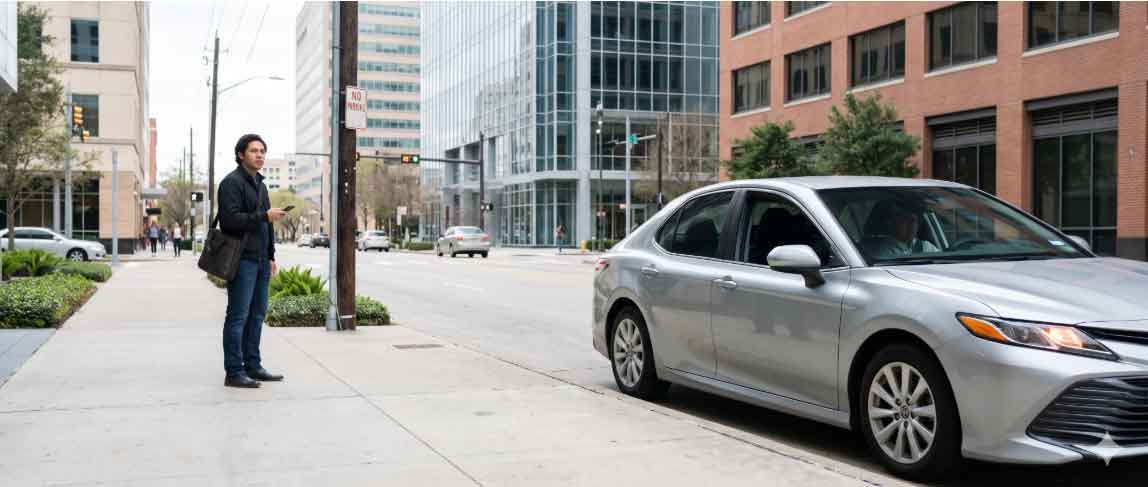
Most passengers assume that a car carrying strangers for money has been checked by somebody. It is a reasonable assumption, and in Texas it no longer describes what actually happens. The rideshare statute does point at a vehicle standard. The standard it points at was substantially repealed at the start of 2025, and what remains in Houston tests the tailpipe rather than the brakes.
The Rideshare Statute Points at a Chapter That Changed
What the law asks of the company
Texas regulates rideshare operators in Chapter 2402 of the Occupations Code. Its vehicle requirements provision directs a transportation network company, for each vehicle used to provide digitally prearranged rides, to require the vehicle to meet the requirements of Chapter 548 of the Transportation Code, and to confirm that the vehicle has four doors and a maximum passenger capacity of not more than eight people including the driver.
Four doors and a seat count are easy to verify. The substance of the requirement is the cross-reference to Chapter 548, which is the vehicle inspection chapter.
What Chapter 548 requires today
The Texas Department of Motor Vehicles states the current position plainly on its vehicle registration page. As of January 1, 2025, non-commercial vehicles are no longer required to obtain a safety inspection prior to vehicle registration. Vehicles registered in seventeen listed counties, Harris among them, are not required to obtain a passing safety inspection but must still obtain a passing emissions inspection before registration.
Inspection requirements for commercial vehicles have not changed, and all commercial vehicles must still pass a commercial inspection regardless of county. A personal car used for rideshare is not a commercial vehicle for this purpose.
An emissions test is not a safety test
This is the part that matters for anyone who works on cars. An emissions inspection evaluates what the engine is producing and whether onboard diagnostic monitors are ready. It does not measure tread depth. It does not assess brake pad thickness, rotor condition, brake lines, suspension components, steering linkage, wheel bearings, wipers or lighting. None of the systems that actually stop a car are examined at any point in the process.
A Houston rideshare vehicle can therefore pass everything the state currently asks of it while riding on cords.
According to personal injury lawyer Lance C. Rudzinski, Shareholder and Managing Partner of Personal Injury Litigation at RTRLAW, the repeal did not reduce anyone’s duty of care, but it did remove the paper trail that used to make a maintenance failure easy to demonstrate. Passengers injured in these collisions often contact a Houston legal professional once it becomes clear that establishing the condition of the vehicle now depends on evidence gathered after the crash rather than on an inspection record.
What Still Gets Checked
Company programs, not public standards
The major platforms operate their own vehicle inspection requirements. These are genuine and they catch real problems, but they are company policy rather than a public standard. The criteria, the frequency and who is authorized to perform them are set by the company and can change without notice, and the resulting record belongs to the company.
Everything else is the driver’s judgment
Between inspections, the decision to replace worn tires or address a brake noise rests entirely with a person whose earnings stop when the car is in a shop. That is not a character observation. It is a structural incentive, and it applies to any owner-operator model.
Why This Shifts the Evidence, Not the Duty
Negligence has never required a statutory violation. A driver who continues operating on tires in obviously poor condition can be negligent whether or not a state inspection existed to catch it. What changes is proof. Where an inspection record once gave a clear before-and-after picture, the condition of the vehicle now has to be established from post-crash photographs, the tires themselves, repair invoices and the platform’s own inspection history.
The company’s position is also structured by statute. Chapter 2402 provides that a driver meeting defined conditions is considered an independent contractor and not an employee of the company for all purposes, which shapes how claims against the platform are framed.
What a Passenger Can Reasonably Notice
You are not performing an inspection from the back seat, but a few things are visible without trying. Look at the tires as you approach, since sidewall damage and uneven wear are apparent from a few feet away. Notice whether the car pulls, squeals or shudders when the driver brakes at the first light. Note dashboard warning lamps that stay lit after start-up.
If something is clearly wrong, ending the ride early costs a cancellation fee and very little else.
If There Is a Crash
Photograph the tires, including the tread face, before the vehicle is moved or towed. Record the plate, the make and model, and the trip details in the app while they are still retrievable. That set of images is often the only contemporaneous record of the vehicle’s mechanical condition that anyone will ever have.

Disclaimer: Guest Posts don’t reflect the views and opinions of Crankshaft Culture. Articles include links to websites for products and services. Crankshaft Culture receives a monetary commission for each guest post.
Leave a Reply